Friday, October 17, 2008
Politics and Fair Use
I read an interesting article on fair use, YouTube, and John McCain this morning in Library Journal's Academic Newswire. It seems that the McCain campaign recognizes the strong contribution that YouTube videos make towards the political process. YouTube, as a result of their continuing legal battle with Viacom, has been very quick to comply with DMCA takedown notices. The McCain campaign has asked YouTube to investigate more closely the request that come regarding political material. So far, Google/YouTube have maintained that this would be impossible. The LJ article notes how this is just another example of how fair use faces numerous challenges in the current climate. Librarians and educators depend on a robust fair use protection of free speech. Looks like I'm on John McCain's side on this one.

Tuesday, July 15, 2008
Meebo on the library website
I continue to be amazed at how well Meebo works as a way to connect with our clients. 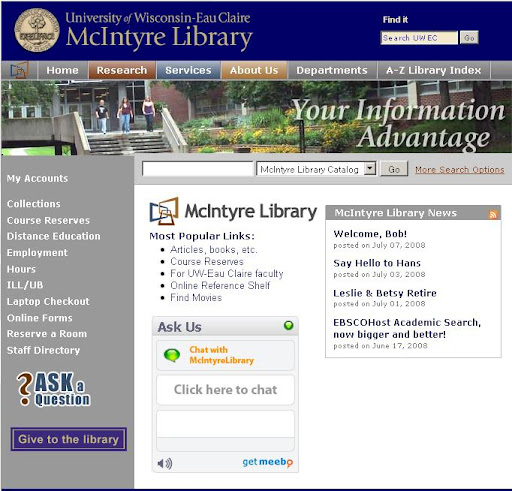
This is my second week working the reference desk from two to four on Tuesday afternoon and both days someone has contacted us (I was on desk today with Marcus, our student worker and he got the question) using the Meebo widget we have on the library homepage.Today someone wanted to know if we had a scanner in the library, which we answered that we did. Then about ten minutes later, a non-traditional student came in. I ended up helping him do the scanning. I thought it all the more impressive since it was one of our older students. This really must have appeal for a range of ages.
This is my second week working the reference desk from two to four on Tuesday afternoon and both days someone has contacted us (I was on desk today with Marcus, our student worker and he got the question) using the Meebo widget we have on the library homepage.Today someone wanted to know if we had a scanner in the library, which we answered that we did. Then about ten minutes later, a non-traditional student came in. I ended up helping him do the scanning. I thought it all the more impressive since it was one of our older students. This really must have appeal for a range of ages.
Wednesday, June 4, 2008
CUWL Conference
Susan Gibbons, Vice Provost, River Campus Libraries, University of Rochester opened up the meeting with an introduction to efforts on their campus to learn more about how students live, work and research. Working with a staff anthropologist they have used ethnographic study techniques to learn how the libraries might better serve students. Many of the things they did are replicable at McIntyre. Ideas that I heard were attracting students to focus groups using $5 and food. They didn't sit around speculating what students need, they asked them. They redesigned their website by giving students mockups of their site and having them circle what was good, writing in what was missing and X-ing out what was useless. Because of what they learned about students and their relationship with their parents, they focused on parents during orientation programs instead of overwhelmed students. They hosted a parent breakfast. Another thing that we could adapt was putting white boards in all the group study rooms and placed movable white boards around the library.
Other highlights:
Other highlights:
- The new Library Dynamics software will allow us to compare our collection with others in the System and other libraries across the country. It looked pretty easy to do but no one really knows all the details about the software yet.
- The document delivery project has opened up more questions about how best to provide access to scholarly material for our faculty. Possibilities include ILL credit cards, everyone joining RAPID interlibrary loan (Madison and Milwaukee use it and praise it), and spreading the funds to more publisher websites.
- Madison will go directly to publishers rather than pay copyright costs when ordering material that would incur those charges.
- The credit cards require more fiscal management time but seem to facilitate document delivery.
Friday, December 21, 2007
Library for the long haul
This morning as I walked into the library on the last day of finals week I saw people sleeping on two different floors as I made my way to my office. That wouldn't be so unusual but for the fact that one woman had a blanket draped over her and the guy had a full-sized bed pillow under his head. This is the first library where I have worked where we stayed open 24 hours during finals week and the week days leading up to it so I assumed they had been there all night. It felt kind of good to know our students feel comfortable enough to make FULL use of all we have to offer. Then I read the article from yesterday's Chronicle..., Who Needs a Dorm During Finals? Everything a Student Needs is in the Library. It looks like our experience isn't that different from anyone else.
Sunday, December 16, 2007
No misscopied call numbers
Last week an e-mail where a colleague was sharing some exciting technologies that are being used by libraries to make their resources more available and more useful to our students and faculty. One really captured my attention because it solves a problem that has always bothered me. I have terrible handwriting and am numerically challenged. This has always been a problem for me as I researched in libraries in the days of the card catalog. I would write down a call number and wander around the stacks until finally arriving at the place where I thought my book should be only to find that I had transposed some numbers. When I became a librarian I realized that I wasn't the only one with this problem. Then came the online catalog and these wonderful small HP dotmatrix computers attached to each terminal. I could just print out the bibliographic information and call number. No more wandering the stacks on a mission doomed from the start. Then came technology updates, networked laser printers that made me feel like an environmental reprobate every time I wasted an entire sheet of paper and toner to print out a bib record and call number. I was back to using those little golf pencils and the backs of envelopes.
Well the message I received last week held the answer to my problem it was in a blog post from Jason the Content Librarian. Jason was writing about a widget being used by the University of Oregon in their catalog that creates a button on the bibliographic record screen. The button allows you to send your cell phone a text message with the title and call number of the book you want. Students can walk up to the stacks knowing they have the correct call number. The widget is written for Innovative Interfaces catalogs. I was told that a librarian at Bryn Mawr had written the original hack and that it was also being used at the Iowa City Public Library. Its probably being used at other places that I don't know about.
Our catalog is a ExLibris Voyager product and I haven't been able to find that anyone has developed a similar widget for it. As soon as someone does, you know that we will be offering it just as soon as we can. While I was trying to find a Voyager version of this widget I did find the next best thing. It is a Firefox Browser add-on by Google called Send to Phone it allows you to do just about the same thing but requires a little more personal intervention. Once you install this add-on to your Firefox Browser all you have to do is highlight something on a page and click a little cell phone icon on your toolbar and a window comes up where you can type in your cell phone's number and indicate your service provider and within minutes the message is on your cell. Of course, there are a lot of other situations where this can come in handy but I am more concerned helping our students use our catalog information on a device with which they are extremely comfortable.
I will still be waiting anxiously for someone to write the hack for Voyager though.
Well the message I received last week held the answer to my problem it was in a blog post from Jason the Content Librarian. Jason was writing about a widget being used by the University of Oregon in their catalog that creates a button on the bibliographic record screen. The button allows you to send your cell phone a text message with the title and call number of the book you want. Students can walk up to the stacks knowing they have the correct call number. The widget is written for Innovative Interfaces catalogs. I was told that a librarian at Bryn Mawr had written the original hack and that it was also being used at the Iowa City Public Library. Its probably being used at other places that I don't know about.
Our catalog is a ExLibris Voyager product and I haven't been able to find that anyone has developed a similar widget for it. As soon as someone does, you know that we will be offering it just as soon as we can. While I was trying to find a Voyager version of this widget I did find the next best thing. It is a Firefox Browser add-on by Google called Send to Phone it allows you to do just about the same thing but requires a little more personal intervention. Once you install this add-on to your Firefox Browser all you have to do is highlight something on a page and click a little cell phone icon on your toolbar and a window comes up where you can type in your cell phone's number and indicate your service provider and within minutes the message is on your cell. Of course, there are a lot of other situations where this can come in handy but I am more concerned helping our students use our catalog information on a device with which they are extremely comfortable.
I will still be waiting anxiously for someone to write the hack for Voyager though.
Wednesday, November 7, 2007
Revolutions of Rising Expectations
I just finished reading an article in the Chronicle of Higher Education titled, "Struggling to keep up" (thanks Colleen). Basically it was about the digital divide in academia. There was always a resource disparity between well funded elite universities and colleges and the rest of us. Scholars and students of my generation expected to have to travel to distant libraries in order to access rare material. Interlibrary loan was a tedious process of searching through what seemed to be miles of the National Union Catalog and waiting weeks for the material if you were lucky enough to find something. Now it would seem, the same scenario is being played out by scholars across the country looking for proprietary digital resources. People are less tolerant of this situation than they were in the past. The false sense of information ubiquity at no cost makes us chafe at the thought that others have access to material we can't get to. Undergraduates seem satisfied with the resources they pay tuition dollars for. It is our researchers and scholars who are becoming more and more dissatisfied with this state of affairs.
Within the University of Wisconsin System we are trying to find ways to address the digital divide between the comprehensive universities and our large research institutions. Currently the System libraries are looking at ways to provide document delivery for articles from high priced journals that our faculty need to support their research. Here at UW - Eau Claire this research takes on added importance because so much of it is predicated on faculty - undergraduate collaboration. As new faculty come to our university, having experienced the wealth of resources available at their post-graduate institutions, they are expecting more from us. We need to work together to find ways to satisfy those expectations.
Within the University of Wisconsin System we are trying to find ways to address the digital divide between the comprehensive universities and our large research institutions. Currently the System libraries are looking at ways to provide document delivery for articles from high priced journals that our faculty need to support their research. Here at UW - Eau Claire this research takes on added importance because so much of it is predicated on faculty - undergraduate collaboration. As new faculty come to our university, having experienced the wealth of resources available at their post-graduate institutions, they are expecting more from us. We need to work together to find ways to satisfy those expectations.
Wednesday, September 26, 2007
Libraries in the Contact Zone
Yesterday I read a couple of articles that I thought were really interesting. It started with the ACRL Blog, “Welcome to the contact zone.” That lead me to a short editorial,” Reference, Cultural Values, and the Contact Zone,” and it appears in Reference Librarian Vol. 47, No. 2 for 2007 . We have it in a print subscription on the second floor. A comment on the blog also references and article by Jim Elmborg from last year in RUSQ, “Libraries in the Contact Zone: Creating an Educational Space” and of course the presentation by Mary Louise Pratt, “Arts in the Contact Zone” that started it all.
In very simplistic terms Pratt spoke about the cross-cultural interaction between dominant and client cultures as represented by the story of a manuscript written in 1613 to the King of Spain telling him how to justly rule the colonies. She interwove the story of the manuscript and her son’s interaction with the elementary education system. Both of these stories dealt with the “zone” that was created by the the complex interaction between the two cultures as they came into contact. In both interactions there was a dominant and subordinate culture. Contact zone theory has a variety of implications for libraries. The main implication that I brought away from the articles was that we often look at our students through our world view not theirs. We expect them to learn our systems. We expect them to thirst for the knowledge that can be gained by a complex research project and not just want to get through it with as little effort as possible. Contact zone theory takes on even greater implications when librarians interact with students from diverse cultures. Read the articles, they explain it much better. I especially recommend the Elmborg article. He never fails to help me think more deeply about art of library science.
Subscribe to:
Posts (Atom)